Fewer young people at 16 with nowhere to go.
The signs show years earlier: attendance that slips, suspensions that repeat, needs that go unmet. Foresight helps schools and local authorities act on them in Year 7, years before Year 11 ends.


The young people who drop out of sight
Some are counted as NEET. Others are on a college roll but rarely there, or have simply dropped out of the count.
- 46,520
- 16 and 17 year olds in England known to their local authority to be NEET
- 32,100
- more whose activity is not known at all
- 42,000
- 16 and 17 year olds on a college roll who missed half the sessions they were expected to attend
- 3.9times
- the risk of becoming NEET for young people who are persistently absent
Children’s Commissioner for England, The Childhood Lottery and Hidden NEETs; Young people and work, the independent review led by Alan Milburn.
Risk of NEET, flagged from Year 6.
A risk of NEET indicator (RONI) is raised for each pupil from the data SixIntoSeven already holds, using the Department for Education’s published risk factors. That is four years earlier than most areas run one.
The flag and a dated history travel with the pupil to secondary school, so the right people act long before Year 11.
- Starts
- Year 6
- Built on
- Published DfE risk factors
- Travels
- With the pupil, with a dated history
- Seen by
- Secondary schools and the council
A once-a-year list, or a live picture
Most areas identify young people at risk of becoming NEET from a list drawn up late in secondary school. By then the pattern is years old.
- When risk shows
- A once-a-year listA Year 11 list, too late to change course.
- With ForesightSigns from Year 7, updated all year.
- What it reads
- A once-a-year listOne or two measures, such as free school meals.
- With ForesightAttendance, suspensions, exclusions and SEND, together.
- Who acts
- A once-a-year listA team who may never have met the pupil.
- With ForesightThe school leads. The council sees every school.
- What is on record
- A once-a-year listEmails and spreadsheets.
- With ForesightEvery plan and decision, recorded as it happens.

What prevention looks like in practice
Four steps, each recorded in one place, so the work survives staff changes and moves between schools.
From Year 7
Notice the signs
Attendance, suspensions and exclusions for every school, set against the national thresholds, so the pupils drifting away are visible early.
SchoolStraight away
Offer support
A plan with a named owner and a review date. A flag starts a conversation with the pupil and their family; it is not a label.
Named lead in schoolIf a placement is needed
Bring them back
Alternative provision stays on the same case, with attendance at the provider and a planned return to school.
Inclusion teamBefore Year 11 ends
Plan the next step
The pupils most at risk at 16 are known well before results day, so their next place can be planned with them.
Transition lead
 1
 2
 3
 4
Your duties do not start at 16.
Local authorities answer for where young people go after school, and for the pupils who fall out of school before then. These are the duties Foresight helps you meet.
Young people aged 16 and 17
Education and Skills Act 2008, sections 10 and 12
Know who is drifting away while they are still in school.
Read the ActStatutory guidance for local authorities, April 2024
Participation of young people: statutory guidance
Find pupils at risk of not participating, and offer every leaver a place by September.
Read the guidanceStatutory guidance for schools and local authorities
Working together to improve school attendance
Every school’s AM and PM attendance, against national thresholds.
Read the guidanceLearners who cannot be in school
Education Act 1996, Section 19
Placements stay on the same case, with attendance and provider checks.
Read the Act
When a young person drops out, the cost falls on several budgets.
High needs, youth justice, the Virtual School and, later, adult services each carry part of it.
Foresight gives those teams one record of each pupil, so the work of prevention, and its cost, can be shared between them.
- High needs: Fewer placements that break down
- Youth justice: Earlier sight of those most at risk
- Virtual School: Its whole extended duty, in view




What changed in Barking and Dagenham
Every school in the borough uses Foresight. These are the borough’s own figures from three years of using it.
- 95%
- of pupils placed in alternative provision were back in mainstream school within 12 weeks
- 27%
- of suspensions involved learners on a child protection plan or in care, down from 39%
- 4weeks
- to reach an inclusion panel decision, where it used to take around three months
Figures from the London Borough of Barking and Dagenham, measured over three years of using Foresight.
Read the Barking and Dagenham storyRead how it works in practice
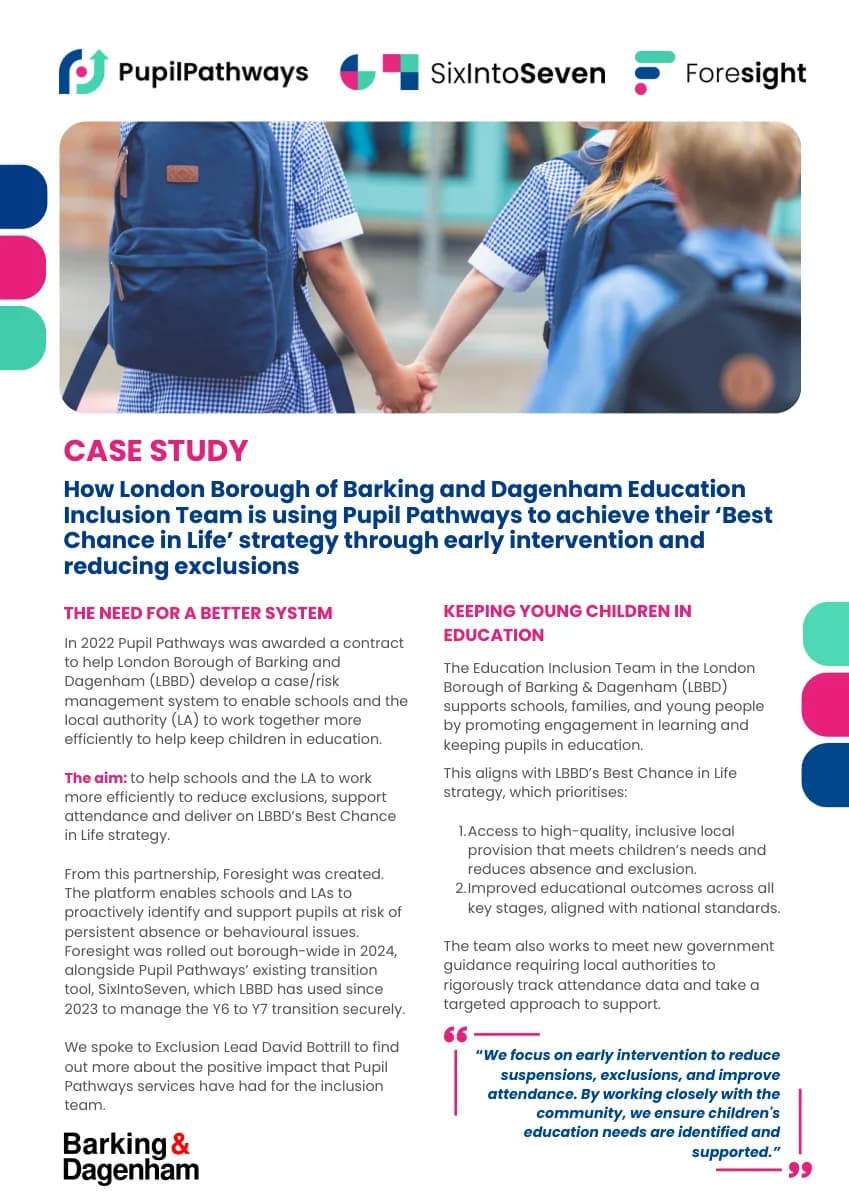
Case study · Barking and Dagenham Inclusion Team
Early intervention and fewer exclusions
How the borough’s inclusion team works with every school through Foresight.
Read it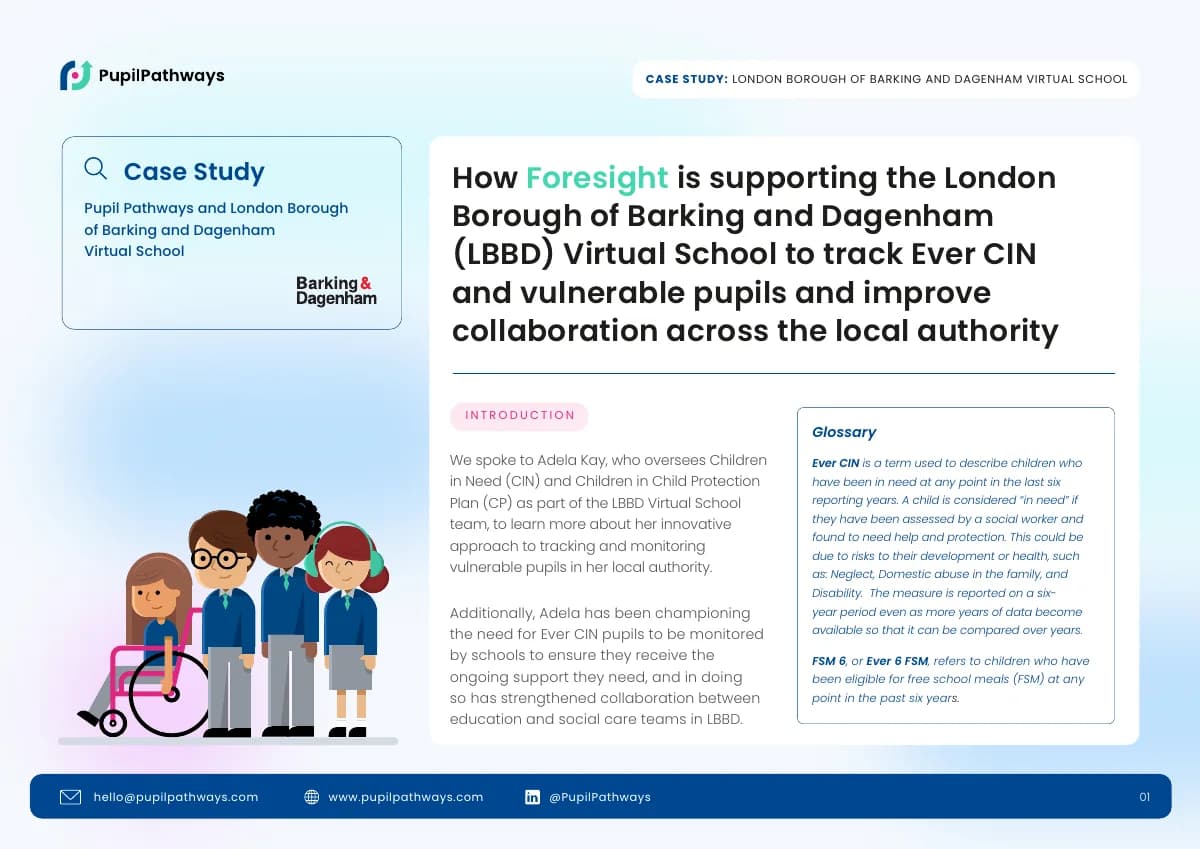
Case study · Barking and Dagenham Virtual School
Following learners known to social care
How the Virtual School keeps one six-year record of children in need.
Read it
Questions about NEET prevention
Is this a NEET tracking system?
No. Local authorities already track 16 and 17 year olds after they leave school. Foresight works earlier, from Year 7, so fewer young people reach that point.
Does it predict which pupils will become NEET?
No. It puts the signs that matter in one place, such as falling attendance and repeated suspensions, so professionals can decide who needs support. PRISM, a risk model that could add to this picture, is in development.
Who uses it?
Schools, local authority inclusion and attendance teams, and Virtual Schools. Each sees what their role needs: a school sees its own pupils, and the local authority sees across schools.
Does it work with our schools’ MIS?
Yes. We connect directly to Arbor and Bromcom through their APIs, and to SIMS and other systems through Wonde. Pupil data, including attendance, is synchronised overnight.
How do we buy it?
We give you a written proposal with the full cost. You can buy through the Government Commercial Agency’s G-Cloud 15 framework or the Low Value Purchase System, or award the contract to us directly.
See which young people in your area are drifting away.
In a 30-minute call we will look at how your area finds the young people at risk today, and where you could act earlier.