Know your Year 7s before they arrive.
Every Year 6 pupil’s profile reaches their secondary school before the summer, and the local authority can see which schools have finished and which need a nudge.




One secure handover for every Year 6 pupil.
Primary schools send each pupil’s profile to their secondary school before the summer holiday. The council or trust running the move sees which schools are on track.
- Who uses it
- Councils, trusts and their schools
- Covers
- Year 6 to Year 7
- Set-up
- Two to four weeks
- Works with
- Arbor, Bromcom, SIMS and more
- How to buy
- G-Cloud 15, or direct
- After the move
- Foresight takes over

Information has to arrive, and be acted on.
The government’s safeguarding guidance expects information to be passed on, read and acted on at every move between schools. Ofsted now judges inclusion in its own right.
In force from 1 September 2026
Keeping children safe in education 2026
Safeguarding detail arrives before the pupil does, with proof of receipt.
Read the guidanceGraded in its own right since November 2025
Ofsted’s inclusion evaluation
Every pupil’s needs, in front of you before September.
Read the guidance
September shouldn’t be the first time you meet them.
Pupils arrive from 30 or more primary schools, each sending information its own way. What helps a learner settle is usually the first thing lost.
How it arrives today
- An email with attachmentsEnd of July
- A spreadsheet in its own formatLate
- A paper form in an envelopeBy post
- A phone callLast week of term
- Nothing at allNever arrived
With SixIntoSeven
One profile for every pupil
- AttainmentExpected in reading and maths
- Attendance96%
- SENDSEN support, speech and language
- Pastoral notesSettles best beside a friend
- Key contactsYear 6 teacher, and Mum
From every primary school, in one format, before the summer.
We wanted timely, succinct data that is usable and useful. The phrase I like to use is: manageable for staff, but meaningful for learners.
Keith Bardsley
Senior School Quality Assurance Officer, Manchester City Council
See SixIntoSeven in three minutes
A short film on how schools and local authorities use SixIntoSeven to manage the move from Year 6 to Year 7.
Less work for Year 6. A head start for Year 7.
The same profile works for both sides of the move.

For primary schools
Send it once. Know it landed.
- Nothing typed twiceBasic details come straight from your MIS.
- One profile, wherever they goEach profile goes to the pupil’s new school.
- Proof it arrivedSee when each one was received.
- Fewer meetingsSave meetings for the pupils who need one.

For secondary schools
Meet every Year 7 before September
- Every primary, one formatEvery feeder school, free for them.
- Before the summerRead profiles as soon as places are allocated.
- Ready for day oneTutor groups and support planned in advance.
- Still there in NovemberProfiles stay to hand all year.
- Agreed onceDeadlines, data sharing and flags, set once.
- Progress you can seeSee who has sent, and who has not.
- A nudge in JulyLate schools get chased in July.
Tutor groups used to be rebuilt in the first weeks of term.
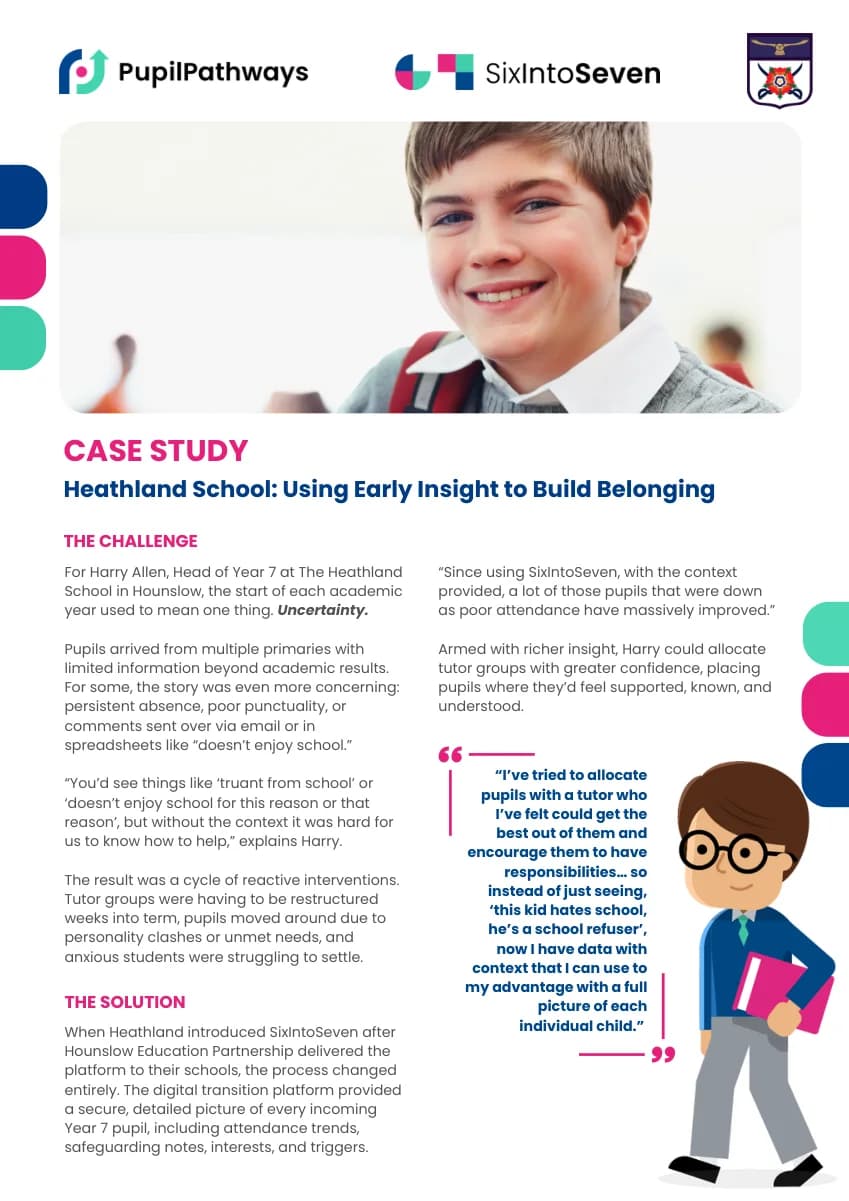
At The Heathland School in Hounslow, pupils used to arrive with little more than their results. Comments such as “doesn’t enjoy school” came over by email or in spreadsheets with no context, so tutor groups were restructured weeks into term and anxious pupils struggled to settle.
Now the Head of Year 7 reads each profile before the summer and places pupils with a tutor chosen for them. Many pupils who arrived with poor attendance records now attend well, and this year nobody has needed to move.
What a spreadsheet can’t tell you
The Common Transfer File carries what your MIS holds. A profile adds what only a learner’s teachers can tell you.
- Attainment
Reading, maths and where each pupil is working.
- Attendance
Year 6 attendance, so patterns show early.
- SEND
EHCPs and support plans, ready for day one.
- Pastoral notes
What worries them and what helps them settle.
- Key contacts
Who to talk to at the primary school.
Safeguarding detail has its own section, seen only by staff you choose.
Seen by the people who need it, and no one else.
Access is set by role, so safeguarding and SEND detail reach only the staff you choose.
- A form tutor and your designated safeguarding lead see different things
- Each school sees only the pupils allocated to it
- Every action is logged
- PDFs for your safeguarding system, and notes into your MIS
Safer than an inbox
A profile can’t be forwarded by mistake, lost in an inbox or saved to a personal device. Each school sees only the pupils allocated to it, every action is logged, and an area shares under one data sharing agreement.
Read about security and data



Every school in view, and every pupil without a place.
While schools share profiles, the team running the move sees where every school stands and which pupils still need attention.
For local authorities- Focus cohort
- SEND, safeguarding and absence first
- Allocation
- Who has a place, who has not, and why
- School progress
- Completion, school by school
- Timeline
- Your deadlines on every dashboard
- Out of area
- Other schools join free
- Appeals
- Held until the place is confirmed
Know who to call first
Primary schools flag the pupils who need a conversation, so your first calls go to the learners who need them most. Every area starts with these, and can add its own.
- Safeguarding
- SEND
- Attendance
- Behaviour
- Wellbeing
- Medical needs
- Young carer
- Looked-after
- Pupil Premium
- EAL
- Your own
See which pupils to plan for first.
Every Year 6 pupil gets a High, Medium or Low transition risk level, from the data SixIntoSeven already holds. The primary school confirms it before March.
Your secondary schools and your inclusion team see who needs the most support, months before September.
- Levels
- High, Medium or Low
- Confirmed by
- The primary school
- Ready by
- March
- Seen by
- Secondary schools and the council
- Decided by
- A professional, every time
Risk of NEET, flagged from Year 6.
A risk of NEET indicator (RONI) is raised for each pupil from the data SixIntoSeven already holds, using the Department for Education’s published risk factors. That is four years earlier than most areas run one.
The flag and a dated history travel with the pupil to secondary school, so the right people act long before Year 11.
- Starts
- Year 6
- Built on
- Published DfE risk factors
- Travels
- With the pupil, with a dated history
- Seen by
- Secondary schools and the council
It doesn’t replace the visit. It tells you where to go first.
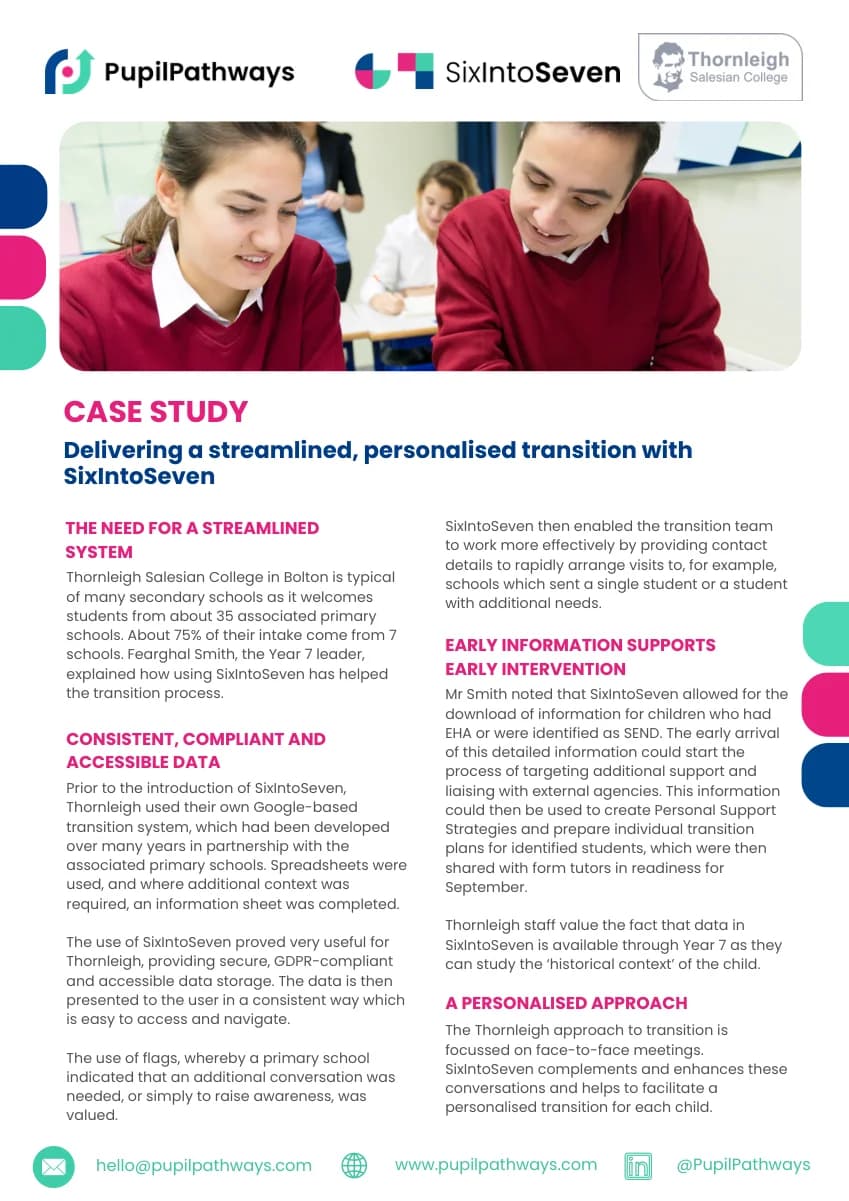
Many secondary schools still visit their feeder primaries, and the profiles make those visits more useful.
Thornleigh Salesian College takes pupils from about 35 primary schools. It keeps its face-to-face approach, and uses SixIntoSeven to decide where to go first.
Set up in spring, ready by September
Most local authorities are set up within two to four weeks. From then on, every school knows what is due and when.
 Year 6
 Year 7
Spring term
Set the timeline
Deadlines, data sharing and local flags, agreed once.
Local authority or trust
Summer term
Primary schools send profiles
One profile per pupil, with SEND and safeguarding added.
Year 6 teacher
Before the holiday
Secondary schools prepare
Heads of Year 7 read profiles and plan tutor groups.
Head of Year 7
First half term
Check in early
Flagged pupils reviewed in the first weeks.
Pastoral lead
See a transition year in your schools.
In a 30-minute call we will show you how a year would run across your primary and secondary schools.
Schools and councils using SixIntoSeven
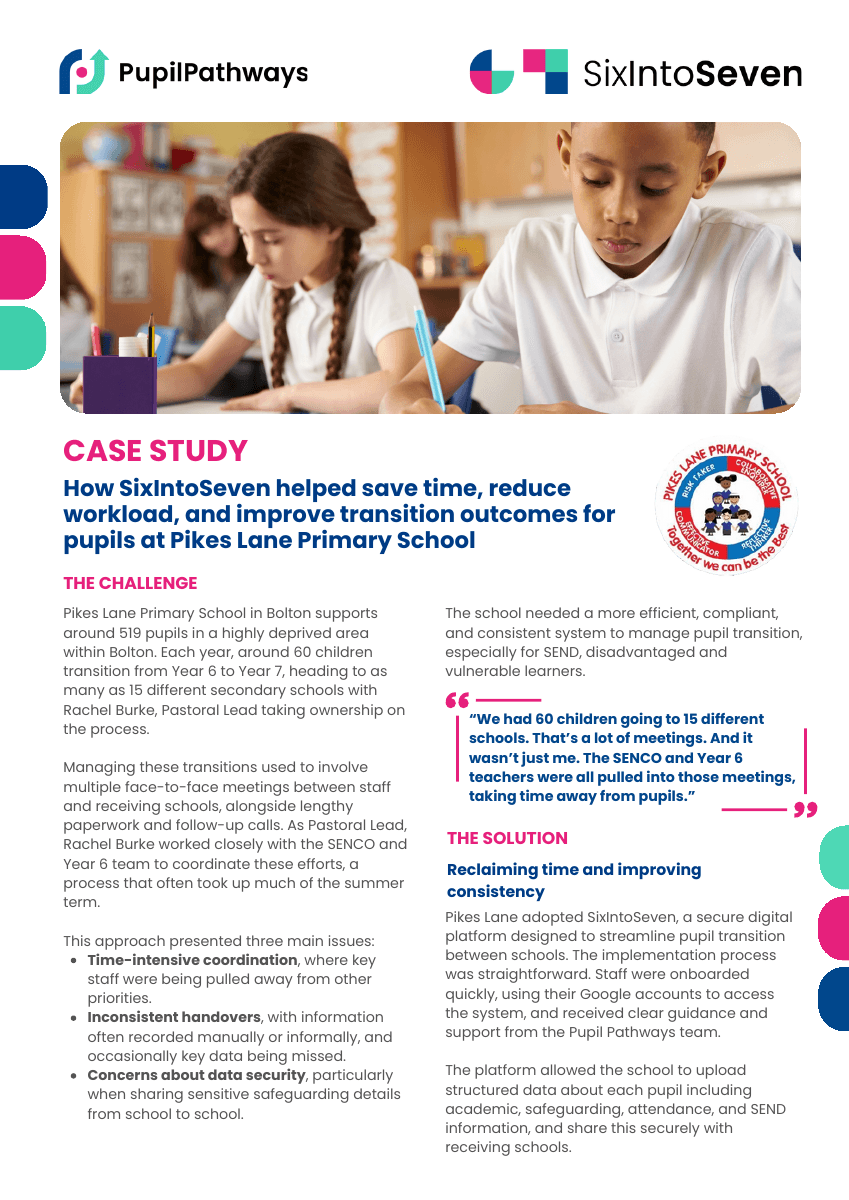
Case study · Pikes Lane Primary
Around 60 Year 6 learners, 15 secondary schools
How one Bolton primary keeps track of where every pupil’s information goes.
Read it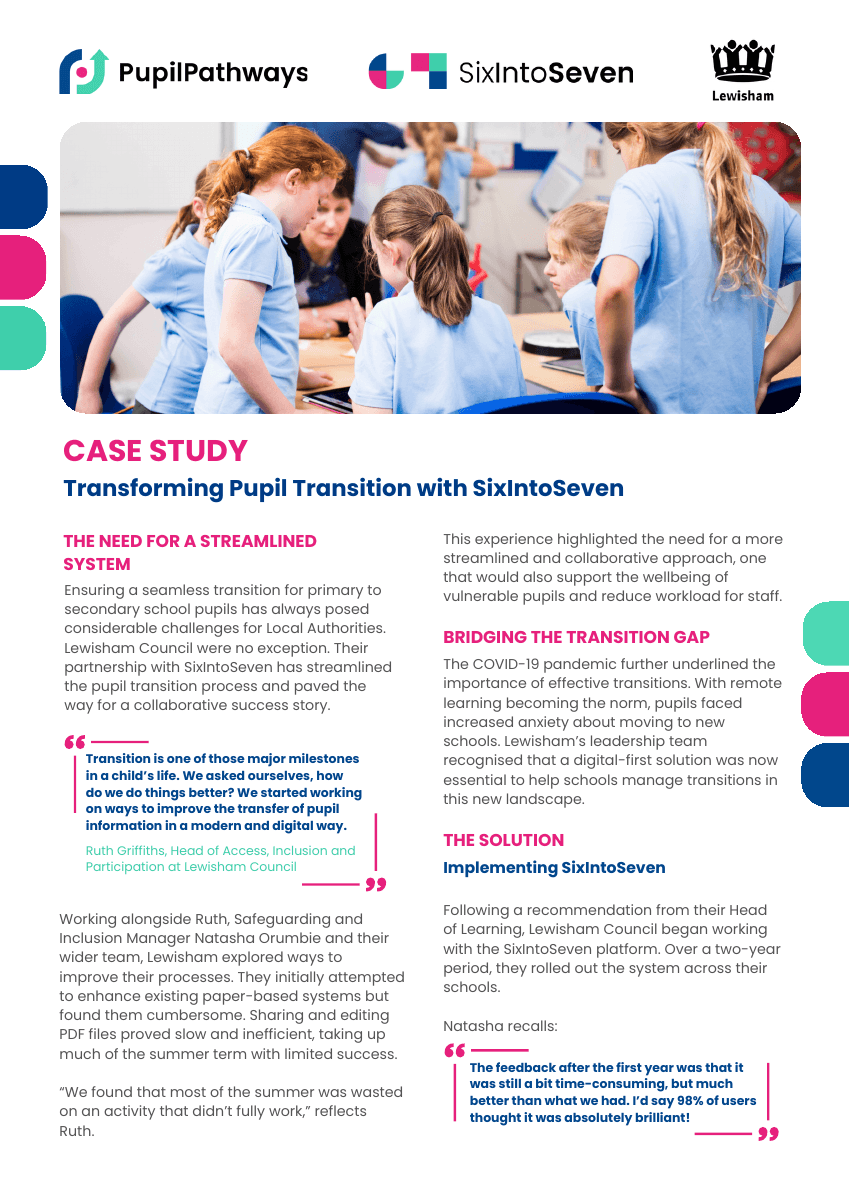
Case study · Lewisham Council
Moving pupil information online for every school
How Lewisham moved every school’s transition online.
Read it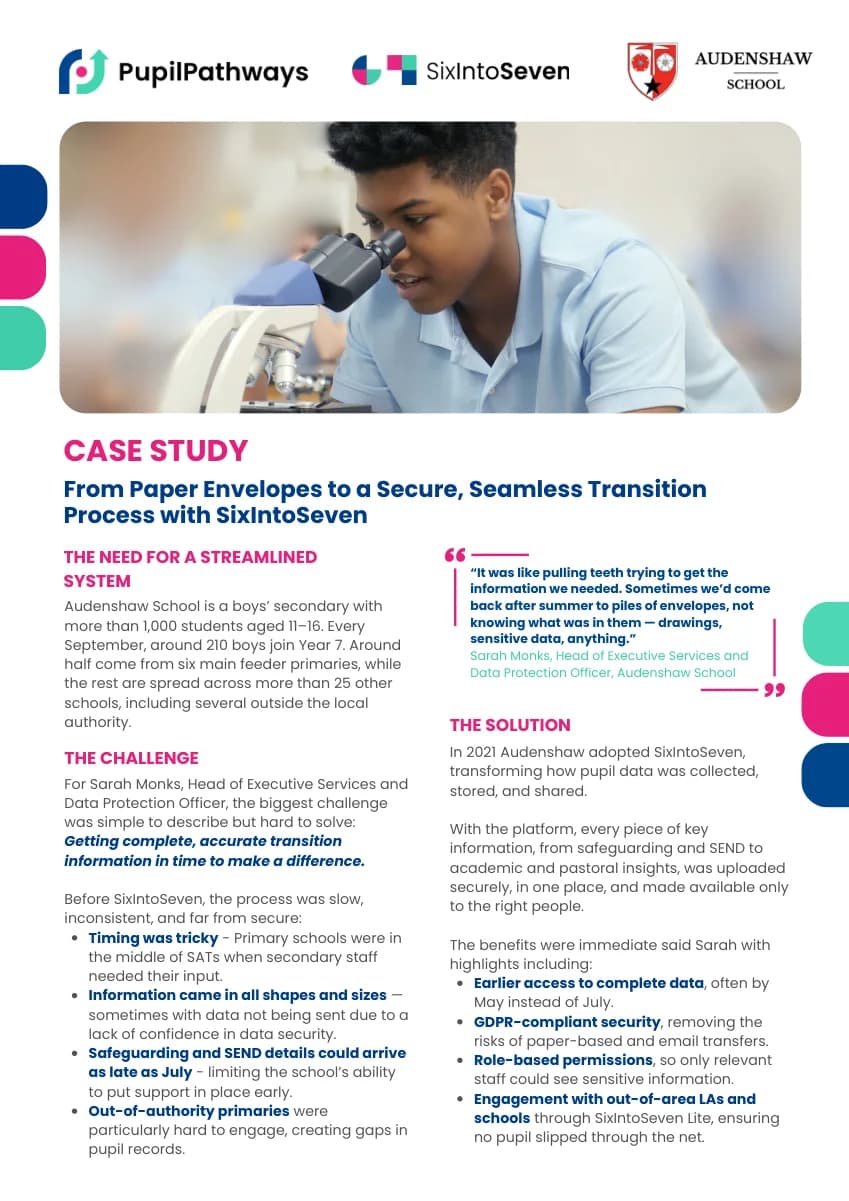
Case study · Audenshaw School
From paper envelopes to information in May
Around 210 boys join Year 7 each year from more than 30 primary schools.
Read it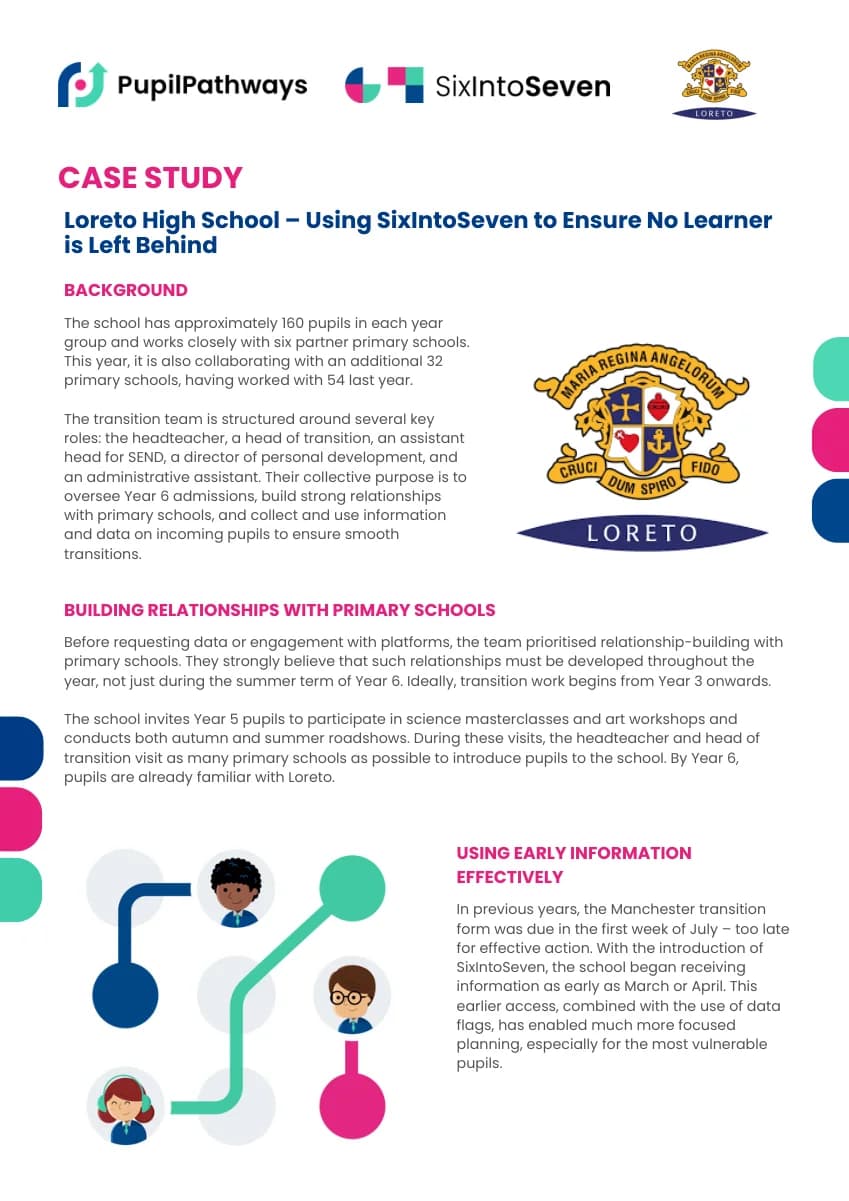
Case study · Loreto High School
Early information for the most vulnerable pupils
How earlier information let Loreto plan support before pupils arrived.
Read it
Questions about SixIntoSeven
What does SixIntoSeven do?
SixIntoSeven moves Year 6 pupil information from primary to secondary schools in one secure place. Primary schools complete a profile for each pupil, secondary schools read it before September, and the local authority or trust can see how every school is getting on.
When can secondary schools see the information?
As soon as a primary school submits a profile and the pupil has been allocated to the secondary school. Primary schools can start adding information from the beginning of Year 6.
What information is shared?
Attainment, including reading and maths, attendance, SEND information such as EHCPs and support plans, pastoral notes, key contacts, and anything else the primary school thinks will help the pupil settle.
How is SEND information handled?
SEND details have their own fields and are flagged for priority attention, so the receiving school can plan support before the pupil arrives.
Which flags can we use?
Flags include safeguarding, SEND, attendance, behaviour, wellbeing, medical needs, young carer, looked-after, Pupil Premium and EAL. Local authorities and trusts can add their own.
Is it GDPR compliant?
Yes. Access is role-based, so each school only sees the pupils allocated to it, every action is logged, and information is encrypted in transit and at rest. Areas share it under one data sharing agreement.
Pupil Pathways is ISO 27001 and Cyber Essentials Plus certified and holds the DPO Gold Standard.
How long does it take to set up?
Most local authorities are set up within two to four weeks, including configuration, school onboarding and training. Schools just need a web browser and a login.
How is this different from email or spreadsheets?
Information can’t be forwarded by mistake, lost in an inbox or saved to a personal device, and you can see which schools have finished.
Can a multi-academy trust use it?
Yes. Trusts use SixIntoSeven to run one standard across their primary and secondary schools, with a view of progress across the trust.
Does it work with our MIS?
Yes. We connect directly to Arbor and Bromcom through their APIs, and to SIMS and other systems through Wonde. Pupil data, including attendance, is synchronised overnight.
What happens while a place is under appeal?
The pupil’s information is held securely and no school can see it. Once the appeal is decided and the place confirmed, the profile is released to the receiving school.
What if a pupil has no secondary place?
The primary school records why, for example a move overseas or home education, or passes it to the local authority. The local authority can see every pupil who is still without a place.
What happens after transition?
SixIntoSeven covers the move from Year 6 to Year 7. To follow attendance, suspensions and exclusions after that, councils use Foresight.
More about SixIntoSeven
- For secondary schoolsPreparing your Year 7 intake
- For primary schoolsSending profiles once and knowing they arrived
- For local authoritiesSeeing every school’s progress before the summer
- ForesightFollowing pupils after the move
- Security and dataHow information is held and who can see it
- Year 6 into Year 7 Transition: Pastoral vs AcademicArticle · 4 March 2026
Start planning next September now.
The spring term is the time to set up. We will show you how a transition year would run in your schools.