Webinar19 November 20261 hr
Building an inclusion strategy that actually means something
Jamie Rogers on turning a commitment to inclusion into clear priorities, actions and evidence. Schools that receive the Inclusive Mainstream Fund must publish an inclusion strategy statement by 31 December 2026.
What you’ll take away
- Questions to agree what inclusion means in your school.
- A structure that links vision, barriers, priorities, actions and evidence of progress.
- A clearer line between everyday teaching, targeted support and specialist provision, including inclusion bases.
- Prompts to test whether your strategy is making a difference for pupils.
Who it’s for
Headteachers, trust leaders, SENDCos, inclusion leads and local authority officers who write or support an inclusion strategy.
About Jamie Rogers
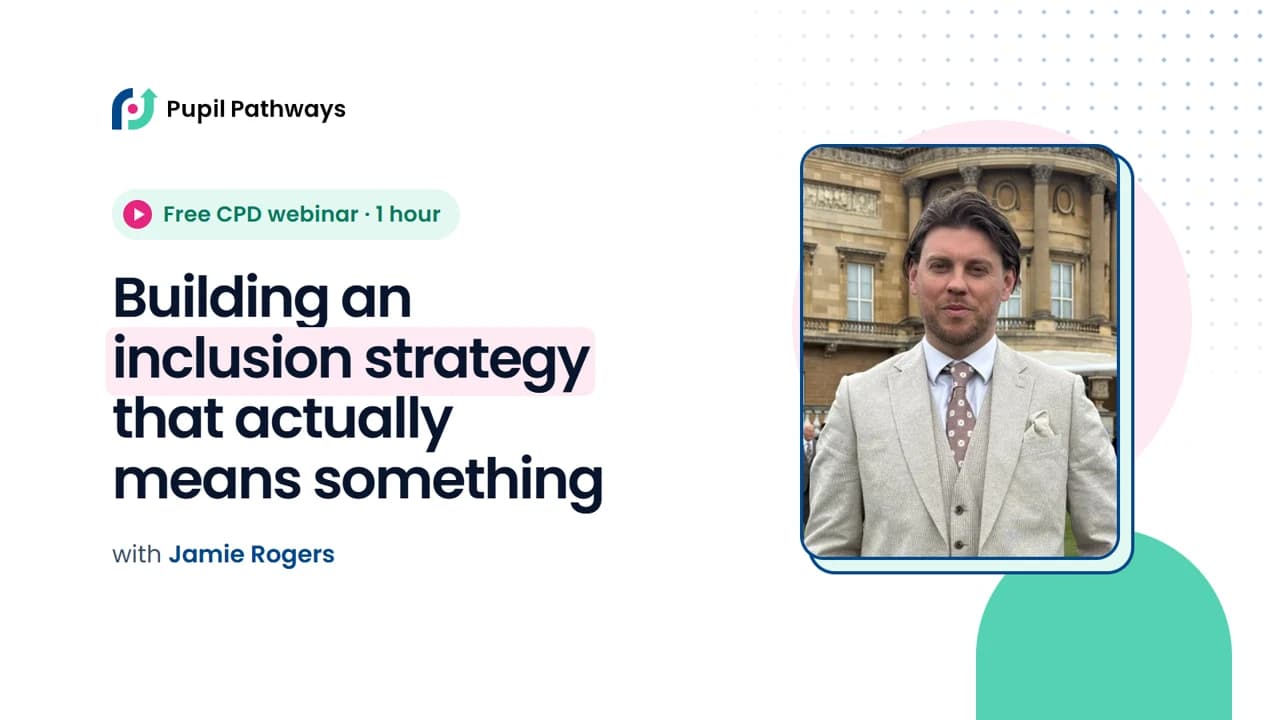
Jamie Rogers works with multi-academy trusts, local authorities and schools across the country. A former primary headteacher, and later Director of Programmes and Partnerships at The Difference, he helps leaders build inclusion strategy, inclusive leadership and inclusion bases.
Transcript
Lizzie WhitlockHi everyone, good afternoon and thank you for joining. We are going to make a start now. So just before we do, I've got a couple of quick housekeeping points before we get going. So we are recording and mics are automatically muted and cameras are off. As we go through, please do drop your questions into the Q&A box. We'd love to receive those. It is a Q&A box, it's not a chat box. And we'll come back to those at the end, and everyone who's registered will receive the recording via email. So I'm Lizzie from Pupil Pathways, and we work with LAs, MATs, schools and settings, and inclusion is at the heart of everything that we do. And we enable strategic oversight and case management for attendance, behaviour, suspensions and exclusions.
We have a focus on prevention and reducing disengagement and the risk of NEET. And we also enable inclusive transition from early years right the way through to post-16. Now, today's session is about building an inclusion strategy that actually means something. And as we know, schools have been tasked to publish their inclusion strategy by the 31st of December. And we can't think of anyone better to help us make sense of that than Jamie Rogers. Now Jamie is the founder and director of JMR Education and a former primary school headteacher who's dedicated his career to inclusive education. Now most recently he was Director of Programmes and Partnerships at The Difference, an education charity and he now works alongside schools, MATs and LAs across the country to turn national policy into practical action.
He's also an advisor to the Department for Education on the inclusion base network for social and emotional development, and he contributed to the Ambition Institute's Inclusive Teaching Framework. And what we particularly love about Jamie's approach is that it's practical and grounded into the reality of school life. So, Jamie, thank you so much for being here. It's over to you.
Jamie RogersThanks, Lizzie. I think that was the nicest introduction I've ever had. So I'm going to try and do that some justice as we step through this afternoon. On screen, you can see the topic of today's session is mainly the inclusion strategy. I will refer to an inclusion framework as we go. And if you want the resources and the slides and some helpful links in there as well, there's a Padlet that's linked in the chat too. But Lizzie, if we step through and make a start, It's quite a lot for us to get through in the last 40, in the next 45 minutes. I won't bore you by talking too much around my intro as Lizzie's just done a great job of it. But I'm also Director of Inclusion currently across Tower Hamlets Education Partnership, working with the London Violence Reduction Unit on its inclusion, relationally safe schools work with multi-academy trust. I'm doing lots of different things. […] If you're anything like me you've probably spent the last few weeks and you're probably looking ahead to the deadline of the 31st of December for the inclusion strategy piece. There's lots to think about in there and I would say there's a lot of opportunities within that too. So if we step through again there please, Lizzie. Lots of my work over the past four or five years since leaving primary headship quite a while ago now has been about how do we bring practice and policy together.
Policy's changing, we're hearing a lot more around inclusion, but as much as that's good in my book, a good step forward, I'm also very interested in how we make that practical on the grounds and share what's actually working. So my work has spanned programmes and research and did a large piece of research into inclusion bases a couple of years back about lots of different strengths and working with all different types of schools. So if you're thinking about groups of schools, maybe you work in a local authority or a multi-academy trust, or if you're thinking about individual schools or academies, I'm hoping this next 45 minutes with me can help you feel really prepared for what's coming when it comes to inclusion strategies. Next slide again, Lizzie. And I think a good place to start with all of this is actually just taking a moment to reflect about what's the classroom that you can think of.
When I ask you the question, what's the one classroom where things just work? And if I ask you the question, why does it work in that classroom? What are the features of inclusion you see? And what do you look for when you're on learning walks when it comes to inclusion? Going to think of lots of different things. I think you'll probably get one or two classrooms from your career, maybe in your current school or past school, maybe it's your classroom. I think certain things would jump out at you. This idea that inclusion is fluffy and sits at the edges of things, it's kind of what the SENCo does down the corridor, is not where things are going. And I think for me, there's a real fine balance and we're talking a lot more about inclusion in the classroom between getting inclusion pastoral care and inclusion in terms of attainment in a good balance. So as you think about class you probably think about purposeful learning environments children on task all children learning children who might have adaptive teaching strategies in place for them and that's quite subtle potentially and you'll be thinking about lots of things within your specific context but what I would say first and foremost is it's so crucial in this work to build on what you've already got.
So I talk a lot about building from what's strong, start with what's strong, not what's wrong, that kind of strength-based approach. There's probably one, two, if you're lucky and you've been doing this work for a while, seven, eight, nine, ten, twenty-four, twenty-five classrooms in your school where good stuff is happening, and the importance of not throwing in lots of new initiatives, all at once, just because we've got to publish an inclusion strategy, is an idea that I'll come back to as we step through the next slide. So we're going to talk about the inclusion strategy. We're going to help you see the bulk of the thinking, give you some pointers that you can take away. But I think it's also important to think about the moment that we're in right now when it comes to inclusion, inclusion pedagogy, cultures of inclusion, and think about that national context as well. And there'll be time at the end to answer any questions that you might have in the Q&A which Lizzie kindly explained to us at the start. So let's get into it a little further Lizzie. A key point in all of this work and I think this is potentially a pitfall of the strategy piece is we can publish a great strategy by 31st of December but I always come back to this point that culture eats strategy for breakfast. We know as great as your strategy might be the work to embed inclusion, to keep building over time, it's an iterative process, it depends on lots of factors. And actually as we come to prepare the strategy, we don't have to take every single thing that we're doing within it, we want to be quite brief in some places, and I'm going to step through the different components as we go. But this isn't just about writing a strategy, longer term we're going to be thinking about this idea of cultures of inclusion.
For me that culture of inclusion and this idea of inclusion by design which we're going to start to hear more often the Department of Education, essentially, Ofsted, we'll talk about it, has lots of different facets. So today is almost like an introduction to some things that I think will be pivotal over the next few years. Inclusive teaching, inclusion bases, how do we capture pupil and family input and voice and pupil experience data, how do we work on our enrichment offer, both co-curricular and extracurricular to ensure inclusion across that piece, Transition, Pupil Pathways is currently hosting the webinar today. It's going to be a huge focus over the next few years. Ultimately, we know we're trying to shift attendance in a positive way. We're trying to increase feelings of belonging for young people. The Milburn report came out this week. It's all interlinked. So I'm very conscious as I talk to you this afternoon that we're providing a snapshot into a much bigger picture and Pupil Pathways do connect with them.
We're going to be sharing lots of kind of opportunities to get more involved in thinking about some of these things over the next few months as well. But keep pressing on there, Lizzie, please. Lots of you will be at different stages with your inclusion strategy. So we'll jump through that slide, but I will, as Lizzie's transferring the slide, make the point that that's quite all right. Actually, some of the communication of this was quite complex. It was quite hard to find it even on the gov.uk website. So knowing where to start, or if you're quite far, you might want to hear about some of these things if you're quite reassured about where you're currently at. So we actually have to do five things, five quite simple things. And the first thing is to think about your statement of intent. I say simple, it's simple if you have sometimes a thing, sometimes a reflect, but also I would say you've already done lots of thinking in your pupil premium strategy, your SEND information report, your school improvement plan as well.
Step one is thinking about your vision for inclusion in your school. That's the piece for me where you zoom out, that you talk about what we're trying to do long-term. What are we working towards? What are we building? Step two is thinking about barriers to learning. And I would say that four to five barriers to learning might well be enough for you. If we load in all the different points of focus that we've got for our school, it becomes quite an unwieldy document. We will step through each of these five areas in a bit more detail as we go as well. Step three is thinking about what are we actually gonna do to impact those barriers? What's the activity we've got planned for this year? Step four, how are we gonna know? What are we gonna measure? And step five, we're gonna be asked to review this work annually. And actually in the first instance, we've got a couple of years, two years before we need to do that first review.
Moving on slightly, Lizzie, this is where I'm gonna start to put the work into a bit more context. And so as I keep saying, culture eats strategy for breakfast. So you might feel quite exasperated as you see on screen here. This isn't me trying to start panic or making myself feel old and thinking about the passing of another year. We've got 42 days until this strategy needs to be published. Actually, if you think about it in terms of working days, if you're breaking up on the 18th, like many schools are, that's just 21 working days to go. Don't let that panic set in too much though. We're gonna break this down so by the end of this time, you're gonna have a real keen sense of where we're going. Yeah, as I said, don't worry. Will get you on track. In the Padlet, you'll also see the document here, which is the Department for Education's Inclusion Strategy template. I'm going to make reference to this. There are some additions that I'm going to suggest that you might choose to put in. You don't have to, but I think you've got to remember this is a document that faces our communities.
Parents will read it, and if it's something that parents will read, we know that at some point it might be held against us, and we want to really make sure we're presenting our school in a positive and strength-based way. So I'm going to potentially add some suggestions that you might think about to add in in addition, but that simple template in the Padlet is the bones and crux of what we'll be referring to this afternoon. And let me place this into context. Again, we know the 31st of December is the pressing deadline. We've got a strategy to write, but actually I think it's bigger than this. It's particularly important to think about when you've produced your strategy, how will you put that into wider context. So on the left hand side there, this little timeline that you can see was a timeline that went viral really from the Times Educational Supplement or the TES and it discusses everything that we've got to do at schools across this academic year. Things like the mobile phone ban kicking in, particularly secondary schools thinking long and hard about that. You might already have done lots of work on allergies and Benedict's Law and we think the new national curriculum actually will be announced before Christmas and after Christmas the social media ban might kick in and lots of unintended consequences will fall out of that for schools and also this idea of an Inclusive Mainstream Fund, the inclusion strategy, it feels quite heavy at the moment for lots of us, the school leaders and I'm conceptualising this as the elephant in every classroom. Big elephant on the screen here, it feels slightly overwhelming, it feels like we're carrying a lot and lots of buzzwords being thrown into the mix, lots of new words, potentially not so new words, lots of things for us to try and unpick and to make sense of.
And this idea also of making sense of it not just for us as leaders but for our teachers in our classrooms as well. How do we make this feel more manageable? And I think on the next slide and there are certain levers that you'll want to think about and within your school. But a great question that I've been asking across many schools that I've been working with is how do we unpick some of this heaviness? And actually how do we place the work that schools are doing in the context of our wider society? And the example I've been using is, a couple of weekends ago I went to visit my mum. My mum is my hero, but she was also working in EYFS, so Reception, early years, and for 27 years. She's just retired a couple of Septembers ago, but she's still always going into school to help out, putting up displays, doing some extra work, work going on trips when it's needed.
So she loves working within schools. And she's got a group of friends who still work in the school. And they meet up every couple of weeks, they have tea and biscuits. And I made the dreadful mistake of going around my mom's house when they were all having their meeting. And they heard about the work that I do in school. And one of them asked me, Jamie, like, oh, you're doing all this work with schools. Why is it so hard right now? Why was our September intake the hardest we've ever had? And we thought last September was bad, but we're just getting this picture of more and more challenge. And that's a useful question, I think, to ask people within our staff bodies who might be further away from this, but to actually think about why do things feel quite so difficult? So that will take us into the next slide, Lizzie. As you do that thinking and ask yourself that question, I'm sure you're all screaming or scribbling down why you think it feels so hard.
And people are pointing to different things with that. Pointing to screen time, the point to potentially poverty and rising poverty. There's a real complex sort of tidal wave. Maybe you're going back to COVID and tracing some of the pupils who are leaving year 11 and year six and their journey through school being heavily impacted by COVID. For me, there's lots to this picture, but it's an important picture to have in mind with our strategy piece. And for me, it goes back to some of these things are just a snapshot. You'll think of many more than this. The one in the middle of the screen there really hits me. Young people are five times more likely to have no friends now than they were a decade ago. And actually, to put that into context of a class, one in 20 young people say they don't have a friend in school. Pretty bleak. And the top there, obviously the use of artificial intelligence or AI is heavily creeping in.
And one of the statistics that I found really poignant there from this YouGov survey was that 11% of all the young people who use AI between ages eight and 17 use AI as a friend. So really, really quite interesting and shifting landscapes. I'm thinking about when I used to go out and play on the street, climb trees, play football, all the things I used to do as a child, I potentially wouldn't let my children do those things now because of safety. So this idea that childhood is really changing. And again, poverty, whenever poverty gets mentioned, I think one of the things I hear certainly from policymakers or lots of people who work around the edges of school is, oh yeah, poverty's increased, but we've introduced breakfast clubs. It's so much more complex than that. Young people are facing overcrowding at home where they live in poverty, lots of children living in absolute destitution, but that creates problems like no mattress, no beds of their own, and the impact on learning when children can't have this healthy sleep hygiene.
All these kind of complex factors are things that we see in almost every, if not every town in the country. It's a complex picture, and it actually can be quite an overwhelming place to start. And as we step into this next slide, Lizzie, I'm hopefully gonna make it slightly more hopeful as we step through. But if you're a reader like me, please read this book if you work with young people working with schools. And it's by a man called Frank Cottrell-Boyce, he's a Liverpoolian, and he was the children's laureate for a period of time. And this book tells the story of Frank traveling around different parts of the country, essentially reading to young people. And the book's got lots of key themes, but why I think it's important for the context of this is it talks about schools carrying far too much and schools actually being the frontline service. Talks about that theft of childhood by poverty, and it talks about reading being relationships and not just about attainment, and actually young people being read to much less maybe in school because of kind of heavy curriculum we've got to deliver, also outside of school by family members is declining and that's potentially one of the things Frank points to as a huge shift in childhood. So that's all the kind of background setting so what can we do about it? Let's step through again Lizzie. I think there are four pieces or four pieces of policy from the Department of Education that we need to think about. Today we're going to focus on the middle one of developing the inclusion strategy and this is going to help us take those first bites out of that big juicy elephant there, the things we've got to think about. But the other things you'll be thinking about, and again we'd love you to join us for future sessions around inclusion bases at the bottom there, enrichment benchmarks and this idea of an enrichment framework that came up as well, and then also something you might not have seen is this idea of inclusive education estates. How do we make our buildings more accessible, more inclusive learning environments? Now you've probably not read all of them, And I can admit, I'll happily admit that I haven't read every bit of those because that's 571 pages in total of policy.
And trying to make sense of that as a school leader is incredibly hard. Each of these pieces of policy were also released in the middle of the heat wave that we had back in June. So the idea that you would have had chance in a heat wave to read them, potentially even more unlikely. But do refer to them, do in the context of the things I'm about to say, look back and make references to them. But let's get into this idea of an inclusion strategy. Now, that's what we're here to talk about today. Let's get through this, simplify it, help ourselves understand what we might need to do before that deadline. The opportunity here as well, and again, there's a temptation to let AI do lots of the work. AI is a very useful tool. Obviously, I've mentioned it, but in it with negative connotations there when I talked about children using it as a friend. But actually in the scheme of our work, lots of us are using it to reduce workload. And it's a temptation to think actually AI will save me here. My friend Claude or Copilot or ChatGPT, step in at the 11th hour and write me a perfectly good inclusion strategy. I've actually seen quite a few schools take that approach. Nothing wrong with it. We're all busy people. I totally understand it.
But one of the barriers within that, though, is actually what we see and what a couple of those leaders have talked to me about is that actually this idea that those strategies that are produced with AI don't necessarily really reflect the reality of our school. And they paint this picture of this panacea of inclusion where money is no object or resources no, no bounds. And it's just not realistic. And the opportunity here is to actually make sense of our pupil premium strategy, our school improvement plan, our SEND information report, and bring together a kind of public facing document that our families, our community will refer to and we'll tie some of that together in quite a simplified way to help us make sense of those big things that we've got to do. So, Lizzie, if we go on to the next slide, this is where we'll really start to step through those five objects or five items that we've got to do that make up this strategy.
So let's push through again into the next slide there. This is also backed by a pot of money, and that pot of money for the average size, if there's ever such a thing as an average school, the average size primary school will receive between £10,000 and £20,000 and the average size secondary school will receive between £45,000 and £65,000. Sounds great but in the grand scheme of school budget that is not a huge amount of money. And so if you want to know how much your schools are getting there's a link at the bottom there to a calculator, the Inclusive Mainstream Fund Calculator. Simply pop your URN into that calculator, and it will give you the amount that your schools get. And you'll make a reference to that as you step through. But Lizzie, onto the actual steps, that's important context, and we'll press through again.
The first thing you have to do is define your statement of intent, your vision for your school. And you're essentially been given a suggested word count for this of 500 words. And within that 500 words, want to spell out what are you trying to do when it comes to inclusion in your school. Before this academic year there wasn't a sort of shared definition of inclusion that was published by the DfE and actually Bridget Phillipson in her white paper quoted this one here from IPPR and The Difference where I used to work. Whole school inclusion means all staff supporting the learning, well-being and safety needs of all children so they belong, achieve and thrive. And Bridget Phillipson basically said, this is the definition of inclusion that we think could work, makes sense. But what's actually important here is that you come up with your own local definition for inclusion.
And that 500 words can feel like quite a lot. And I would suggest like the example on the board there, it's also helpful to have a short version that our staff or teams can refer to that we might talk about in assemblies. And there are some examples I've seen of really kind of catchy things like safe, secure, successful or some people have gone with things like every day, every classroom, you might have a kind of value statement or visions and values that you talk about in your school that lend themselves perfectly to the inclusion definition. You'll want to flesh that out a bit more, but actually within those 500 words, we can probably do quite a lot of bringing inclusion to life and spend some time articulating it as well. The other things you might include as well as that kind of catchier, more memorable statement are on the next couple of slides. So let's step through. I'll step through one more time just there. I think within the file, I'll come back to what you might include, but a couple of key points to think about there are this is a parent and family and carer facing document, so we want it to be jargon-free and easy to understand. We want to set out an inclusive vision, but if we do promise too much or promise specific actions and we've got budgetary constraints, be careful that that's not creating a rod for your own back later on.
And really spending some time thinking about what you want your vision to capture. You might already have a well-defined vision for inclusion of the policies. Don't throw everything away. Bring together what you've got and try and do that condensation into those 500 words. Next slide, again, please, Lizzie. Now those 500 words are potentially quite a vast thing to approach. And some of the actual other, this kind of suggestion on the template are some of the other pieces of the document you might actually just spell out a bit more of your rationale that you might talk about who the kind of makeup of your young people are, what inclusion means to us, the ambition we might have and more broadly how we're approaching inclusion across our school. So you can be quite liberal with what you talk about within those 500 words. I've actually included some examples that I thought were interesting examples of a primary and secondary school on the Padlet. So do check out the Padlet link as well.
Going further than that, probably not for today, some schools have also started to bring it to life. This is a kind of a mock-up from one of the schools that I've worked with in the past, but they've actually used graphic design and that's a one step further. Think about how you make that vision statement visible. How are you going to start to talk about it, to help it underpin a culture of inclusion? What we don't want is for this to just be a dusty PDF on the school website that we don't make any reference to, and we kind just leave it there forever more. How are we going to take the vision that we've set out and make it something that we talk about regularly too? Let's move into the next slide if we can, Lizzie. This is where I think it gets quite interesting, the barriers to learning section. We step through again there, Lizzie. This is where I was talking about the addition that you might make to the template.
On that template there, we've started very much with setting out the vision, and then the template says, name your barriers. Now that misses out for me a real opportunity to start with the positives and tell the positive story of your school. Start with what's strong and not what's wrong. Actually, what are the young people in our school good at? And also, where in our inclusion practice are we demonstrating really great practice? Are our young people honest, kind, reflective? Do we win borough sports competition? Say something positive to help those people who read your strategy get a sense of who your school is and who the young people in your school are. And also be proud of where we're maybe above our average attendance because of the work we've done or we're reintegrating young people who've been using alternative provision. Whatever it might be, say something positive in my top tip here to help lens this as a real strength space and not go jump into barriers and deficits.
Lizzie, we'll step through now onto the barriers and move through again just there. And the guidance is quite explicit here. When we're thinking about barriers, we want to choose commonly occurring barriers that block access to learning. And I'll show you what I mean by that again on the next slide, just there. Now, we're great as school leaders as saying, we have got 56 EHCPs in our school, or we've got high levels of social, emotional, mental health. We're great at describing the demographics within our school. What we're not so great at doing is being specific about where those demographics meet learning and block participation, which is the task in hand for us here. So actually, when we're thinking about children who might have social and emotional mental health needs, where that might be challenging is after unstructured activities, for example, lunch or playtime, when those children return to the classroom, and they become dysregulated, or it takes them a long time to settle into learning.
We really want to be quite specific around what we're suggesting those barriers are. Now, some people have zoomed out and gone for like wide, broad statements. We're being asked to measure this. So we want to try and do something that we're already potentially doing or we're already focused on that we can provide metrics for to say that we're impacting it. Now, there's lots of different tasks to take, but I think it's really important there that specific is better. And if you can be specific with those barriers. And that's a useful framing actually for lots of the inclusion pedagogy work that's coming out, which I'll refer to in the next couple of slides as well. So let's step through, please again, Lizzie there. Some reflection questions on screen that were just there, which stay on this slide if you can, Lizzie. It's worth checking when you said those barriers. Would our family say that they're the same barriers? Would our teachers say the same thing? You'll have your perspective as a leader, but you'll want to get other people's perspective as well.
Now, when it comes to perspective, evidence is a great place to start. Use the evidence of your SEND profile, those demographics that I've just talked about, also your attendance data, progress data, or attainment data, there'll be lots of different facets that you might want to think about when it comes to how do we actually pinpoint those barriers too. Next slide, if we can, Lizzie. Another kind of interesting reflection from reading the guidance, reading the template, is that this idea of pupil, parent voice, gathering pupil experience data is no longer optional. How are we currently capturing pupil voices? Potentially a question you might go away and ask after this. Now, don't worry if you haven't got really stringent things in place before the deadline. This might be something you come back to later. But certainly what you might think to look at is school council, family voice groups, maybe governors.
How can we get those perspectives into our guidance? And I'll make one last point on the next slide around pupil and parent voice. Lots of people are starting to survey their young people. Lots of people are using things like the engagement platform. This capturing of pupil voices are particularly rapidly developing space. For me, there's a really interesting and quite simple way to look at this. And that's the questions that Ofsted actually ask through their pupil survey questions. Seven or eight really simple questions. If you're in the Ofsted window, even if you're not, really useful questions that you might ask your young people. And I think they're linked in the Padlet. I'll double check and make sure that you've got them there after the session too. Step in through, once you've identified your barriers, obviously jot them down on the template, it's quite simple box to put these in. I'll make the point again that I don't think you need to go much beyond five or six different barriers.
I would actually say five is probably the optimum number. We could by all means say everything we're doing when it comes to inclusion, but I'm not sure that's necessary. I also think that your school improvement plan, SEND information report, all these places or other places where you might go for information too. One more again, Lizzie. Choosing the activities, I think, is potentially the hardest step here. You're going to be quite good at already knowing where you're at when it comes to inclusion, the things you've discussed when it comes to inclusion. But actually pinpointing what are we going to do about it. You might already have these activities in flow, and it's perfectly OK to talk about something that you've started already. Just because the 31st of December is the publication date for the inclusion strategy, it doesn't mean that you have to start a whole heap of new stuff.
These reflection questions are the questions that I think are crucial to us. Obviously, which of the barriers are we thinking about for each activity? But also, is there enough evidence base behind it? We're being asked to reach for strategies that we know work, maybe they've worked in our schools in the past, or we've got evidence of them working elsewhere. Can we deliver quality and consistency? Let's not set out something that we can't actually deliver and because again, it will held against us later on. And if we're saying we're focused on something that we've done no work to. And four, thinking about which part of the universal or targeted support offer you're focused on. The Department of Education is publishing resources all the time to try and support schools with that. The two that I think are particularly useful, We can go along one, Lizzie, if that's okay. The Education Endowment Foundation's Guide to Inclusive Teaching.
And this is a really interesting, interactive resource to refer to that breaks down some of those pedagogies, inclusive pedagogies, that you'd want to see in the classroom. It's a great resource for setting CPD, working with early career teachers, and it just has lots of simple videos that show you and demonstrate and model some of those strategies as well. Great thing to think about if you're thinking about adaptive teaching, if you're thinking about inclusive teaching in the classroom, if you've got quite classroom focused barriers to consider, that's a great place to start. On the right hand side there is the inclusive teaching framework from Ambition Institute. Lizzie mentioned that at the start of the webinar and I did a lot of work on this sort of social emotional mental health section, but it's essentially a scaffold and a guide to the five main areas of development when it comes to special educational needs that that you might see in your mainstream classrooms.
And it gives you thinking, support, and guidance to what are the pedagogies that we might use in a given mainstream classroom to support young people with those given needs. Well worth a look as well, and we'll make sure that's in the Padlet. If we keep stepping through, Lizzie, I'll just make a point there because I've mentioned adaptive teaching around adaptive teaching at the moment is probably, along with inclusion, one of the things you're talking about a lot in school when it comes to this. And adaptive teaching is incredibly important. It's a great way to teach, but actually it's not the only show in town. And what we need to also consider when it comes to a culture of inclusion are some of those things that might be a little bit less visible to us when we're doing our walkthroughs or our learning walks or popping into classrooms. And actually thinking around what's the relational practice that we've got?
Have we developed strong relationships between young people and other young people, young people and adults. Is our curriculum appropriately sequenced? Are we using assessments to really understand the gaps or needs or adaptations that our young people might need? So I'll just make a point around that, that actually, yep, adaptive teaching might well be one of your barriers, one of your activities to address your barriers, but actually think about that wider piece on inclusion as well. Next slide there, please, Lizzie. And I mentioned the inclusive education estates policy, when I mentioned those four policies that I think all of us need to start to think about. And it's a long piece of guidance, but these images on screen are from what an infographic within that piece of guidance. And this infographic covers things that you might go away and spend money on to get ready [unclear].
[Unclear] your strategy, or to make your school more inclusive. And actually there's a pot of money from the Department of Education, which is available through local authorities that you can apply to if you've got things like this that you need to do. So although it's not immediately obvious in terms of, you know, when we talk about activities you might jump to adaptive teaching, you might jump to screening tools, you might jump to any number of things, actually improving your estate is a perfectly legitimate activity to have within your strategy as well. We'll keep going through Lizzie, again, coming back to those reflective questions around what are we going to address, but also that risk of a narrow view, where we're describing that we're going to pick three to five barriers, it can be quite specific, it can feel quite specific. And I think that's where we need to also balance that across there with the ambition statement for inclusion, the vision statement being really clear on those wider aims as well.
One more, please, Lizzie. I always come back to the conditions for making inclusion real. And that kind of specificity, if that's a quite difficult word to say at the end of a long Thursday, being really specific with those barriers might feel counterintuitive. But I think that a wider culture of inclusion piece is something to keep coming back to. And those questions around, is learning irresistible? Does it feel like it's worth it to be in class? Can children see the success that they're having and where they're getting to? Can they be themselves? And actually can they access learning, but also can they experience challenge, resilience and overcoming challenge to achieve? So I think they're just some wider zoomed out questions that you might want to consider as well. We'll keep going again, if that's okay Lizzie.
Now onto the intended outcomes. This is where it gets slightly simpler. These last couple of sections you'll be glad to hear are slightly easier to do. The deep thinking around your vision, barriers being specific, consulting, gathering the evidence is probably going to take you the bulk of the time. Hopefully, you've seen from those observations I've just shared, that actually you've probably got a lot of the answers already. When it comes to intended outcomes, this is all about how are we going to measure what we're doing to know that it works. If we keep going, Lizzie, success can be measured, or being pushed and you might think about any of these eight buckets. I'm pretty sure as you start to think about your activities, you'll see dotted lines and connections between what you set out as your activity and these areas as well. And you've been asked to push and push to identify metrics that you'll measure. Now some of those metrics might be obvious, things like attendance data, less behaviour incidents, you'll have harder statistics around them. But it's also okay to set up case studies, capturing that kind of qualitative kind of supportive description around the impact that's been had as well. So as you're choosing your activities, it's important to think about as you choose it, what might I measure to make sure we know that we're on track with all the trajectories that we've set up as well. Next slide please, Lizzie.
Yeah, we'll jump through one more. I think we've explained that kind of mix of hard statistics and softer tells as well. Within the guidance are seven principles of inclusion and they're as you can see on screen here and actually I think all seven of these principles are things I can get behind. I don't think there's anything too controversial in here. We all want these things for all schools and all you're asked to do is to make a connection between the activity that you you set out and which of these seven areas you think is most fitted to. So if you're setting out early intervention, it'll link nicely to number two. If you're thinking about developing a forest school, maybe outside area, and put some money into that inclusive estate piece, it might be number seven. And it is as simple as saying which principle with a number, where you've marked down on the template what your activities are.
So might sound quite complex, but you'll really quickly make those connections as well. Next slide, please. Lizzie, and we'll jump through that reflection question again, because we haven't got the chat on the go. And then annual review. This is the bit where lots of us are sat here now in November, 2026 thinking, okay, annual review, let's worry about that bit in 2027. But I think the important thing here is being really clear on what you're measuring to help you in this, to help the future you really understand and make sense of what you've tried to do. We've got two years in the first instance, so we'll be pushed to review it in December 2028. So we're not gonna spend too much time dwelling on that just now because we're approaching our Q&A session time and slot for asking and answering any questions that you might have as well.
But I'll go through the last couple of slides before we get to the Q&A. This I think is hopefully underpinning everything you've heard from me today. The idea that the strategy is not the work, culture eats strategy for breakfast. But what it can do in terms of why this could be a useful exercise to spend time on is it makes the work visible, focused and reviewable. So as you're listening to me today, 31st of December, not many days left until the end of the school year before we break up for the winter holidays, is answering these quick questions. Who's going to actually complete the draft? If you're on the call with us today, I imagine it might be you. But how are you going to get some input from your families, from your pupils, are you going to take it to school council? Maybe you can even refer back to it if you've got other plans you've provided where you're going to survey young people across the year. It's perfectly okay to publish your first draft of the strategy on the 31st. But actually, we're also told it's totally okay to adapt it as you go. So you might actually say, oh, a new piece of information is emerged, a new priority is emerged from data, attainment data, mocks, whatever it might be. And it's okay to make those changes as you go, as long as it's obviously not changing it every day, but making those tweaks periodically and also sharing it with governors. Many of you will want to get that signed off before the 31st of December with governors, but it's also okay to retrospectively sign that off after the Christmas period as well. And I think this one is something I do worry about for several schools. Who holds the keys to your school website? Who has the actual authority, the password, essentially, to log in and upload a PDF to your website to make sure it's done. Try and make sure you speak to that person before the 18th of December before you go off for your holidays and make sure you've got opportunity to get it uploaded as well.
Now I'm not quite sure how anyone's going to check. I'm told that people are going to be checking for inclusion strategy on the website. I'm not sure the consequences but I think the main thing is we want to have this uploaded and we all want to enjoy our holiday period as well. So I think think Lizzie, I might have miraculously kept us to some time there. The wider picture piece we've talked a little bit about as well, but if you're interested in any of the pieces of work that I've mentioned here before we get into the questions, I'm sure we'll have opportunity at future webinars to come back to it, talk to them through, get in touch with myself, get in touch with Lizzie, and we'd love to share the future plans on that with you too. To. Yeah, perfect. A couple of other links in the Padlet. There are my email address, obviously, Pupil Pathways, contacts details as well. There's also some really great reading.
This particular blog just here is of a school's journey across three or four years to introduce a culture of inclusion. So they talked a little bit about the strategy in the blog, but that longer term work, which I found quite inspiring actually. And they've used this acronym a shift and talking a lot around how that culture evolves over time. Great read if you've got time. Obviously, you can get your strategy done first and then do the reading or do it the other way around. But I would heavily encourage you to have a little think about that. And then second slide along here, the next slide along, Lizzie, is this great blog from FFT's data lab around actually when we're trying to measure things, it can be quite difficult to use some of the metrics that have been developed around belonging and mattering and I think if you're thinking about that kind of outcome section of what I've just broken down that's an interesting read to give you some food for thought as well. Lizzie that is the Q&A now and hopefully that's given people in the room a sense of the inclusion strategy the kind of mechanics of what you might have to do but really happy to answer any and all questions as well. And Lizzie, I know you've got some pre-prepared questions that you might want to ask too.
Lizzie WhitlockYes, thank you so much Jamie. So many practical takeaways there, it was really, really valuable. I love what you said from making sure that you've got access to your website, because sometimes we can take that for granted. And then also looking at, you know, what your cohort is good at, you know, start with what's strong, not with what's wrong. I think that's such a great positive spin to put onto it. Yes, we do have some questions here. Keep them coming in. If you think of any more, just drop them into the Q&A box and we'll get back to those. Here we go. So, you did cover this off a little bit and I'm going to join two onto each other here now, Jamie. But if a school hasn't started its inclusion strategy yet or budgets are really tight, What's the first thing they should do? I know you mentioned about starting with what you're strong at, starting with what you've done already, but building on that, what can schools do?
Jamie RogersIt's a good question. And in terms of not having started yet, I think first and foremost, you're not alone. Working with lots of schools up and down the country who are just in that position. And again, I go back to this wasn't necessarily brilliantly communicated with us. Actually, actually it's don't panic. And what I've set out there is probably a couple of hours worked to get a bulk of that strategy in draft form. If that really, in terms of you've probably got lots of things already. So try and get that head space. Take a morning to work off site if you can. I know that's a bit of a luxury for lots of us. But actually, don't panic is the first thing. Budgets are incredibly tight. And I think I mentioned the kind of Inclusive Mainstream Fund calculator there. But lots of us, that money that I mentioned, It's probably already been absorbed elsewhere in the budget, probably floating around. And this isn't an accountancy exercise.
And we should talk a lot around what we're already doing, those little additions that we might do, any partnership working that we're doing as well. And I guess the reality of all of this is, and I go back to this idea of not setting up this panacea of what we're gonna do, like, you know, we're gonna put loads of money behind it, like be realistic with what you're setting up in terms of what we can deliver. And the fight for more money for this is definitely something I'm behind. Lots of people I work with are pushing and pushing for that with the powers that be. But the reality is, you know, we haven't got a magic wand to create more resource and finance and that's difficult. And we're doing a very difficult job in challenging times. Many of us are doing it very well.
Lizzie WhitlockRight. Thank you, Jamie. I've got a logistics question here, actually. Great question. Do we need to have the document on the website or is it OK to have a whole page of the website dedicated to the strategy?
Jamie RogersSo that's a great question, really technical question. So my understanding of the template is actually just this suggestion. I would probably have it, if you have it as a one page on your website, call it the inclusion strategy page, make it really clear that's what it was. I would potentially just, if you can, make sure with your governance, I'd probably suggest that you take the page or the strategy to your governance to get a trail of it being signed off in minutes. I think that piece is really important for us all to think about this. How are we getting that governor and trustee input?
Lizzie WhitlockGreat. Thank you, Jamie. Oh, this is a great one as well. So how can schools make sure the voices of pupils and families, especially the most vulnerable, shapes their strategy?
Jamie RogersIt's a really interesting one. And this is where I'm quite passionate around pupil voice because actually, you know, we've been sold lots of things, you know, lots of new initiatives that we've got to think about in schools. And it doesn't have to be these complex surveys, it can, you know, talk to young people, ask them questions. And I think, you know, we use the term hard to reach or I like to use the term need to reach, those need to reach young people. Just ask them questions about their experience at school on a one to one basis, if you can, with adults they're comfortable with, maybe they're trusted adults, got to be mindful that lots of children sometimes tell us what they think we want to hear. So really simple actually that interviewing people an informal interview, that kind of conversation in chat with them is a great place to start and sampling those children who we might not usually go to who put themselves forward as prefects or school councillors. And on the family side that's a long-term thing to get families to engage with things like policy documents and things like that. Lots of schools I've seen using kind of coffee mornings to introduce it, asking parents to come in. Typically those parent governors will have a say but actually going out asking questions on the playground being quite you know obviously a lot easier for primary schools and inviting people into school is definitely important. And also being proactive and front footed on it where we often wait for you know negative things to happen to make those relationships or call home for young people, doing that in a positive way, inviting people into schools as much as possible.
You know, getting pupil experience there and pupil voice and family voice right does take a bit of time but I think it starts with those simple conversations.
Lizzie WhitlockBrilliant, a few more questions here as well. I really like this one, so once the strategy is actually published, how will a school know whether it's actually working?
Jamie RogersGreat question and I think this comes back to how we review the strategy and the importance of those measurements that we set up and you'll get sense in all your data obviously that you traditionally track around attendance and you'll see in your data you're knowing attainment but actually I think it comes back to being really clear in what we're going to measure in that kind of outcome section that I talked through. The more specific we can be with that towards the strategy I think that gives indicators of headline outcomes of what's been achieved. So great question, there's lots to think about for it and essentially I think leaders will have their kind of fingers on the pulse. I would say that kind of two-year window is a long time to wait before you come back to and revisit this. You might want to build it into SLT cycles, leadership meetings or you might want to build into trustee meetings, governor meetings. I think come back to it before that two years. I think obviously creating time to do that is always difficult in terms of busy meeting agendas. Doing that simple thing and coming back to it maybe every six months, three months, every term, whatever it might be, that cadence means that it's not going to be a shock in two years that, oh, this didn't work. And leaders are really good at that as well.
Lots of us who lead on inclusion are thinking about how to be measuring inclusion all the time.
Lizzie WhitlockBrilliant. Thank you, Jamie. A couple of questions here, actually. This is from a secondary school, how do I get teachers on board? This is a SENDCo, when they're already stretched and it just feels like another thing, you know, another initiative, another thing on the to-do list.
Jamie RogersIt does feel like another thing, totally great point and a really difficult thing to get right. And this comes back to, for me, this is kind of a two-pronged approach. It's how it's led from the top. And, you know, I can hear in that SENDCo's question there that SENDCos are often left to write these strategies alone, but this is the direction of travel, certainly where Ofsted might go in the future. And I won't say too many political comments on Ofsted as frustrating as they can be. That is going to be something that also talks more and more about the part of education is deep in its policy commitments around inclusion. That kind of stick will come through. But this has to be a shared endeavour across the leadership team to get this off the ground and to have impact, which can be slightly harder to achieve than just me saying that.
And then on the other side, I think going back to some of the things I talked about there, quite deliberately talking about that changing childhood of what it's like to be a child in Britain, it's massively changed in the past few years. And I go back to those things that my mum and her friends were talking about when I went around and they were having their cup of tea. Essentially the job is evolving massively before our very eyes, the needs are rising and acknowledging how hard that can be I think is quite refreshing. But also to try and do some of that kind of cultural work around this is now everybody's job, it's not just one person's job. So it's a really difficult process. I'd love to chat through with that person, do email me as well if that's helpful. Helpful but yeah lots of you know lots of kind of bigger pieces of longer term work would be needed to do some of that.
Lizzie WhitlockLovely yeah I love that it's that holistic whole school approach. Question from primary school now. They have a lot of children waiting for EHCP assessments or outside support. What can they do in their strategy for those learners while they wait?
Jamie RogersIt's a really great question And actually there's lots we can do. So I think that the first and foremost, kind of push here with the inclusion strategies as much as possible, and thinking about the universal offer and the universal offer strengthening that will help more and more young people. But we've also got those children who might potentially just need more targeted support than that. They might be waiting in specialist places. They might be waiting for EHCPs. They might have just needs that are very difficult to meet within our resources. And that's where I'd urge you to think about, yeah, and I'd love to engage with that person to learn a bit more about the specific cases for how to make those generic statements. Is where lots of schools are thinking about their inclusion base, what the inclusion base might look like within their setting, and kind of how you might work.
And this will be a big thing in the next few months as the Department of Education kind of thinks more about this around how local schools work together to provide specialist support across groups of schools, even those that aren't academies. How do you potentially two neighbouring schools, one who might have great speech language communication support, and one who might have great moderate learning difficulties to support and practice within their schools, how might they share some of that, those kind of expertise and practice across their schools? So yeah, the reality is it's a very difficult thing to do. Inclusion bases seem to be the kind of bridging gap for lots of people at the moment. They're hard things to get right. And maybe there'll be a subsequent session where we can talk about that, but also love to start with that individual too.
Lizzie WhitlockAbsolutely. That was a great question. I think we've got time for one or two more before we wrap up. Keep them coming. We can always follow up with those afterwards. So I've got a practical question here. How long should the strategy be? This particular person, SLT in the secondary, is worried that they might spend weeks on a big document when Ofsted just wants to see what's happening in classrooms. What can we say about that?
Jamie RogersI think that leader's probably quite on the money in terms of, again, culture eating strategy for breakfast, what's actually happening on the ground. And the examples I've shared in the chat will give you a good sense of length. Not that long, actually, is the suggestion. That might evolve over a couple of years, you might add to it, but certainly 500 words for that vision statement isn't too long. The barriers can be quite brief. So it's interesting to see what other people have done, which is always where you should start as a leader. So those examples in the Padlet will really help I think give a sense, but totally agree. Like this is a piece of work that's important to invest time in thinking about, but spending weeks and months on it potentially isn't the greatest return on your energy and actually what's actually happening on the ground is crucial.
Lizzie WhitlockAbsolutely. Thank you for answering all of those, Jamie. And that's all we've got time for in terms of the questions today. Some really thoughtful questions there. So thank you for bringing them in and posting them into the Q&A box. And Jamie, a big thank you to you as well. If we didn't get to your question today, don't worry, we'll pick these up in the follow-up like I mentioned before. And again, anyone who registered today will get a copy of the recording in the next couple of days. Now, with the 31st of December deadline not too far away, if you'd like support with your inclusion strategy, Jamie is the best person to talk to. So Georgia is just going to pop Jamie's details in the Q&A box now. So if you want to get in touch with Jamie at JMR Education, his details will be there. They'll also be in the Padlet, which has the link to the presentation. So you'll all be getting that as well via email. Now equally, if you'd like to hear more about Pupil Pathways and how we support inclusive case management and transition. We'd love to chat. Georgia is also popping my details in there as well into the Q&A box. And thank you everybody for spending your Thursday afternoon with us. Another big thank you to you, Jamie. And everybody, good luck with your inclusion strategies going forward.
More on inclusion
All articles Vulnerable pupil tracking should show support came before penaltiesThe Department for Education's updated guidance on the 2027 LAMSA data collection puts local authority attendance support in…Read the article
 Belonging, Mattering and the People Who Make It Happen: Reflections from My First NAPCE Annual ConferenceBelonging, Mattering and the People Who Make It Happen: Reflections from My First NAPCE Annual Conference By Helen Baker, Head…Read the article
 NAVSH 2026: Strengthening systems, relationships and opportunity for learners in careThe NAVSH 2026 Annual Conference this week brought together Virtual School Heads, local authority leaders, educators and…Read the article
See how it would work in your area.
Book a call and we will show you the part of the System that fits what you are working on.